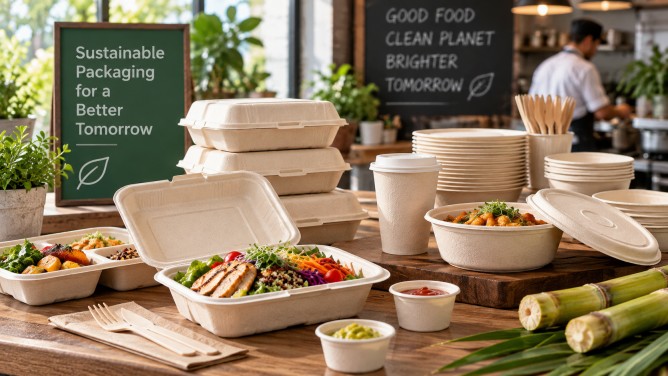
Sugarcane bagasse packaging, a molded-fiber food packaging material, is made from the fibrous residue left after extracting juice from sugarcane. This material is crafted into various food containers such as plates, bowls, trays, and clamshells, finding its use in commercial foodservice, catering, retail, and delivery. Shenzhen Grizzlies Industries offers both standard and customized molded-fiber packaging solutions, including options with coatings and laminations designed to meet specific foodservice needs.
The production of bagasse packaging involves multiple steps, starting with cleaning and pulping the fiber, followed by molding it under heat and pressure to create three-dimensional containers. The process encompasses stages like fiber preparation, pulping, molded forming, hot pressing, drying, trimming, quality inspection, and packaging. This manufacturing method allows for the development of diverse container configurations, including varying depths, wall structures, compartments, and rim designs tailored to specific requirements. Additionally, custom molds can be produced for OEM and private-label projects.
Molded bagasse containers offer structural strength, making them suitable for handling, stacking, transportation, and food delivery. They are commonly used for foods such as rice, noodles, fried dishes, pasta, and curries. For items with higher oil or moisture content, additional barrier technologies can be integrated to enhance resistance. The natural appearance of the molded-fiber surface can be customized with structural designs and embossed logos. While bagasse is generally used in compostable packaging formats, coated or laminated products must be assessed for their complete structure, including barrier layers, films, inks, adhesives, and lids, to determine appropriate disposal methods.
The packaging options include standard molded bagasse for dry and semi-dry applications, barrier-coated bagasse for foods needing greater grease or moisture resistance, and laminated bagasse for applications demanding higher resistance and broader temperature capabilities. Depending on the specifications, multilayer structures may incorporate materials like PLA, PET, CPET, or EVOH. These variations enable foodservice operators to choose packaging based on menu items, barrier needs, lid compatibility, and sealing method.
Shenzhen Grizzlies Industries, with over 15 years of manufacturing experience, operates 11 production bases with more than 280 automated machines, boasting a monthly production capacity of up to 200 × 40HQ containers. Their manufacturing capabilities include mold development, structural customization, logo embossing, private-label production, PFAS-free barrier integration, and more. Before full-scale production, sample testing with actual food portions helps evaluate dimensions, liquid resistance, lid fit, stackability, and barrier performance, allowing for necessary adjustments. For further inquiries, Shenzhen Grizzlies Industries Co., Ltd. can be contacted at +86 137 1519 2986.
Legal Disclaimer:
The information contained in this article has been provided by independent third-party contributors, clients, or content partners. We do not independently verify the accuracy, completeness, legality, ownership, licensing, or reliability of submitted content, including text, images, videos, trademarks, or other media materials. The submitting party is solely responsible for ensuring that all content, including images and media assets, complies with applicable copyright, trademark, licensing, and intellectual property laws. We disclaim liability for any unauthorized use of copyrighted or proprietary materials by third parties. If you believe that any content published on this platform infringes your intellectual property rights, kindly contact the author above for prompt review and resolution.