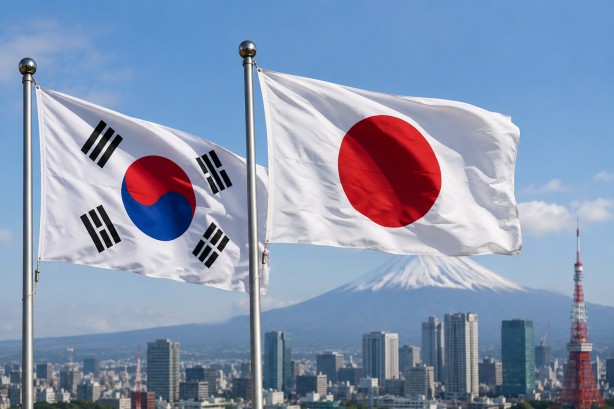
Japan’s political landscape is shifting further to the right under Prime Minister Sanae Takaichi, a development that poses new challenges for its relationship with South Korea. This shift raises concerns about the potential impact on historical and territorial disputes that have previously been set aside to foster diplomatic cooperation. Traditionally, Japan and South Korea have maintained a “two-track” strategy, keeping historical grievances separate from areas such as security and economic collaboration that require closer partnership. However, a recent report by South Korea’s Institute for National Security Strategy cautions that Japan’s increasing conservatism could destabilize the progress achieved in these diplomatic efforts.
Recent tensions have been triggered by visits from Japanese politicians to the Yasukuni Shrine, a site viewed controversially due to its links to Japan’s wartime past, and Japan’s revived territorial claims over the Dokdo islands, known in Japan as Takeshima, which are currently under South Korean control. While Prime Minister Takaichi refrained from visiting the shrine on August 15, the anniversary of Japan’s World War II surrender, she did send a ritual offering, a gesture that did not go unnoticed. In contrast, several senior Japanese officials did visit the shrine, leading to formal protests from the South Korean government.
Amid these developments, South Korean President Lee Jae Myung has adopted a balanced stance. While acknowledging the historical grievances that linger between the two nations, he stresses the necessity of maintaining and enhancing cooperation with Japan. This approach highlights the importance of addressing sensitive issues without compromising the broader goals of bilateral relations.
Experts caution that the ongoing disputes over historical events, territorial claims, and wartime controversies could jeopardize the effectiveness of the “two-track” strategy. They argue that unless both nations make tangible progress in resolving these contentious issues, while simultaneously expanding practical cooperation, the diplomatic relationship could suffer. The situation underscores the delicate balancing act required to navigate a partnership fraught with historical complexities while aiming for a more stable and cooperative future.