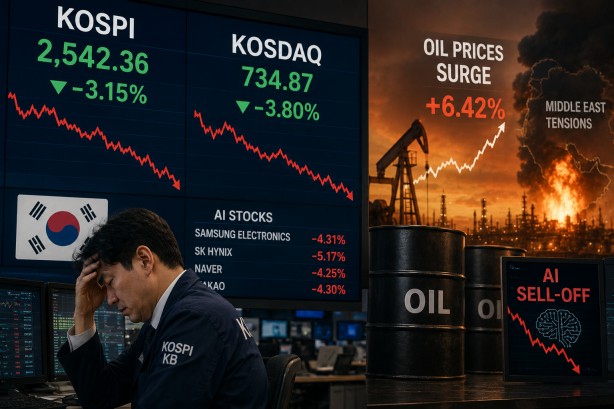
Asian markets experienced a mixed start to the week, with South Korea’s Kospi index plummeting nearly 5% on Monday as investors offloaded stocks linked to artificial intelligence amid mounting concerns over the sector’s valuation. The decline in South Korea was largely driven by significant losses in key technology firms, with Samsung Electronics falling 4.4% and chipmaker SK Hynix down 3.3%.
Elsewhere, market movements varied. Hong Kong’s Hang Seng index saw an increase of 2.1%, while China’s Shanghai Composite gained 1.2%. Australia’s benchmark index also saw a slight rise, whereas India’s Sensex dropped by 0.9%. Taiwan’s market remained relatively stable, buoyed by a 2% gain from Taiwan Semiconductor Manufacturing Co.
The global tech sector is under scrutiny as investors grow wary of potentially inflated valuations due to the surge in spending on artificial intelligence projects. This sentiment was heightened by the introduction of Kimi K3, a new open-source AI model from Beijing-based Moonshot AI, which has intensified the competitive landscape in this rapidly changing industry.
In the energy sector, oil prices surged, with Brent crude rising to $90.40 per barrel, up 2.6%, and U.S. crude climbing 2.2% to $83.58 per barrel. This increase was fueled by escalating tensions between the United States and Iran, which have sparked fears of broader disruptions in the Middle East. The situation has had a noticeable impact on global oil supplies, as evidenced by a slowdown in tanker traffic through the Strait of Hormuz, a critical passage for energy exports.
On Wall Street, the previous week concluded on a negative note, with the S&P 500, Dow Jones Industrial Average, and Nasdaq all recording losses. The tech sector was particularly affected, with chip stocks such as Nvidia, Broadcom, and AMD among the biggest decliners.